What is STEM Education? Meaning, Benefits, Examples & Career Opportunities
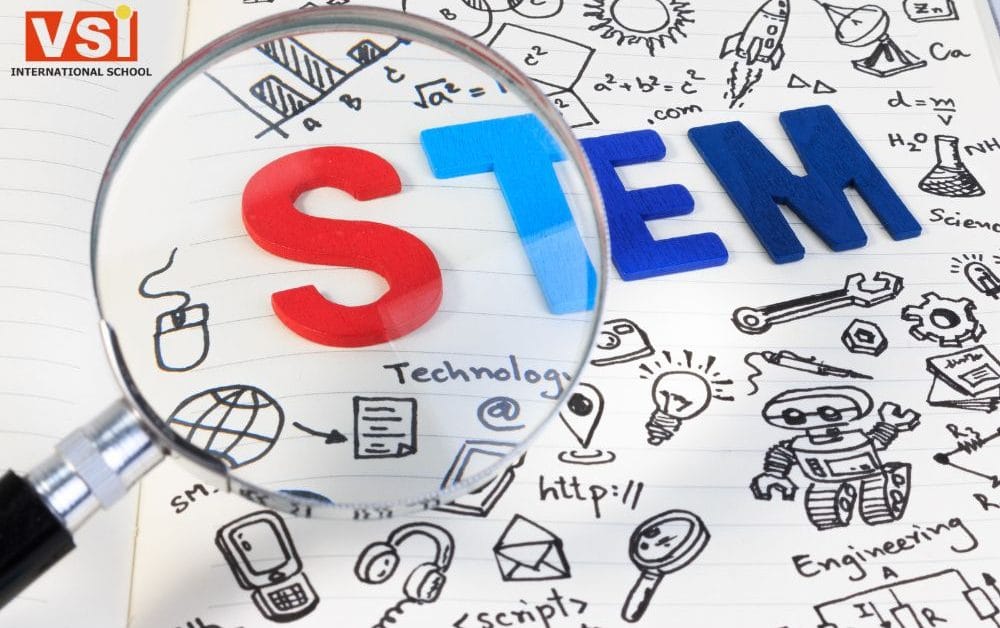
STEM Education (Science, Technology, Engineering and Mathematics) is a multi-disciplinary learning methodology where classroom education and practical problem solving go hand-in-hand. STEM education is deemed to be one of the key approaches to learning due to its ability to make learners think critically, creatively and innovatively as well as to collaborate and become digitally literate. Through robotics, artificial intelligence, renewable energy, healthcare technologies and more, STEM makes sure students prepare themselves for the future. Contrary to teaching different subjects individually, STEM education focuses on applying various fields together to address practical problems.
Key Components of STEM Education
- Science: Encourages inquiry and exploration, teaching students about the natural world through observation, experimentation, and analysis.
- Technology: Involves the use of tools and resources to solve problems, create new products and improve existing processes.
- Engineering: Focuses on the design, building and testing of structures, machines and systems, fostering innovation and practical problem-solving skills.
- Mathematics: Provides the foundational skills for logical reasoning, critical thinking and problem-solving, essential for understanding and applying scientific and technological concepts.
Read More How to Score Full Marks in Math?
Benefits of STEM Education
Critical Thinking and Problem-Solving
STEM education promotes critical thinking and problem-solving skills by encouraging students to ask questions, conduct experiments, and analyze data. These skills are essential for navigating complex problems in both academic and real-world settings.
Creativity and Innovation
By integrating multiple disciplines, STEM education fosters creativity and innovation. Students learn to think outside the box, develop new ideas and create innovative solutions to problems.
Digital Literacy and AI Readiness
In the current technological world, being digitally literate is not an option. Through STEM education, students learn about coding, computational thinking and even about artificial intelligence. This prepares students to be responsible digital citizens in the future when they pursue careers in technologically driven fields.
Adaptability and Future Skills
STEM education promotes adaptability, resilience, and lifelong learning. In view of the fast-changing world of work, a student that gains competency in STEM is better prepared to learn new technology.
Collaboration and Communication
STEM projects often require teamwork, promoting collaboration and communication skills. Students learn to work effectively in groups, share ideas, and communicate their findings clearly.
Career Readiness
STEM education prepares students for a wide range of careers in high-demand fields such as engineering, computer science, biotechnology, and environmental science. These fields are critical for economic growth and innovation.
STEM Education vs Traditional Education
| Feature | STEM Education | Traditional Education |
|---|---|---|
| Learning Style | Project-Based | Theory-Based |
| Focus | Real-world Problem Solving | Subject Knowledge |
| Skills Developed | Critical Thinking, Innovation | Memorization |
| Assessment | Projects & Practical Work | Exams |
| Collaboration | High | Moderate |
Real-World Applications of STEM Education
Economic Growth
STEM education drives economic growth by fostering a skilled workforce capable of innovation and technological advancement. Countries with strong STEM education systems are better positioned to compete in the global economy.
Job Opportunities
The demand for STEM professionals is growing rapidly. Careers in STEM fields often offer higher salaries and more job stability compared to non-STEM fields.
Global Competitiveness
STEM education ensures that students are prepared to compete in a global economy. It equips them with the skills needed to tackle global challenges such as climate change, healthcare and cybersecurity.
Read More How to score 100% in CBSE board?
Top STEM Career Opportunities in 2026
| Career | Field |
|---|---|
| Artificial Intelligence Engineer | Technology |
| Data Scientist | Mathematics & Technology |
| Robotics Engineer | Engineering |
| Cybersecurity Analyst | Technology |
| Software Developer | Technology |
| Biomedical Engineer | Science & Engineering |
| Environmental Scientist | Science |
| Renewable Energy Engineer | Engineering |
Implementing STEM Education
Project-Based Learning
Project-based learning (PBL) is a key strategy for implementing STEM education. PBL engages students in hands-on projects that solve real-world problems, making learning more relevant and engaging.
Integrated Curriculum
An integrated curriculum combines STEM subjects into cohesive learning experiences. This approach helps students see the connections between different disciplines and understand how they work together.
Use of Technology
Incorporating digital tools and resources enhances STEM education. Technologies such as virtual labs, coding platforms and simulation software provide interactive and immersive learning experiences.
Professional Development for Teachers
Effective STEM education requires well-trained teachers. Professional development programs help teachers stay updated with the latest STEM teaching strategies and technologies.
STEM vs STEAM: What is the Difference?
The STEM concept comprises science, technology, engineering and mathematics while the STEAM approach is based on adding arts in order to foster creativity and innovation.
Conclusion
A STEM education is not simply about teaching sciences and mathematics. It is an education system oriented towards the future and helps the learners to gain vital skills necessary for thriving in our modern society such as problem solving, being creative, working with others and using advanced technologies. With the development of new technology like artificial intelligence, robotics and big data analysis, a good STEM education becomes very important for both a successful academic and professional life.